
Dumb and Dangerous
A nuclear armed Donald Trump should terrify us all

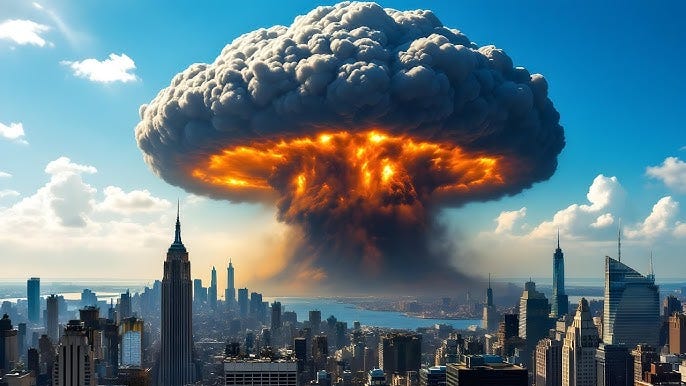
Imagine for a moment Donald Trump sitting in the Versailles-decorated Oval Office, trying to figure out what to do if some suicidal maniac on the other side of the world decides to launch a nuke our way. Does it scare you? It should.
The most frightening aspect of nuclear weapons has never been their explosive power alone. It is the speed at which decisions must be made, the lack of perfect information, and the absolute dependence on human judgment in moments where judgment is most likely to fail.
That reality sits at the center of the recent Netflix film The House of Dynamite, which imagines a single intercontinental ballistic missile headed toward the United States with no confirmed source. The movie’s tension does not come from the missile itself, but from the moral and psychological weight placed on the person who must decide what happens next.
That premise is not speculative fiction. It accurately reflects how nuclear command works. Presidents are given minutes, sometimes seconds, to interpret incomplete data, assess probability, and decide whether to end tens of millions of lives in response to a threat that may not even be real.
History is filled with close calls caused by sensor errors, misread radar signals, and technical malfunctions. The world survived those moments not because systems were perfect, but because leaders hesitated, questioned assumptions, and feared the consequences of being wrong.
This is where the danger of leadership temperament becomes unavoidable. Nuclear deterrence depends on restraint at least as much as it depends on strength. It requires empathy, humility, and the ability to imagine lives beyond abstractions on a screen. It also requires a tolerance for uncertainty and a willingness to absorb criticism for not acting immediately. When those traits are absent, the system becomes brittle, and brittle systems break catastrophically.
Trump’s presidency demonstrated, repeatedly and publicly, a pattern of behavior that should alarm anyone who thinks seriously about nuclear risk. He showed little patience for nuance, dismissed expert advice when it conflicted with his instincts, and interpreted restraint as weakness.
He personalized criticism, responded to perceived slights with escalation, and framed complex global relationships as zero-sum contests in which dominance mattered more than stability. These are not merely character flaws. In the context of nuclear command, they are structural hazards that could end civilization.
Empathy matters in these moments not as a moral luxury, but as a stabilizing force. A leader who can imagine civilians in other countries as real people is less likely to treat retaliation as a branding exercise or a demonstration of toughness. A leader who understands that being feared is not the same as being respected is less likely to confuse global annihilation with victory.
Trump’s often bizarre rhetoric and unsteady actions consistently suggested a shallow understanding of these distinctions. He spoke casually about nuclear weapons, joked about their use, and seemed drawn to the symbolism of overwhelming force without grappling with its irreversible consequences.
The most unsettling possibility in a scenario like the one depicted in The House of Dynamite is not that a president might make the wrong decision under pressure. A president might welcome that decision as proof of importance. When ego outweighs caution, the question shifts from “What will save lives?” to “What will make me look strong?” In a nuclear crisis, that shift is fatal.
Deterrence theory assumes rational actors who seek to avoid catastrophe. It breaks down when leaders are impulsive, grievance-driven, or indifferent to suffering beyond their immediate circle. In such cases, the existence of nuclear weapons becomes less a safeguard against war and more a loaded gun placed in the hands of someone who enjoys the feeling of holding it. The threat, then, is not hypothetical missiles from unknown enemies. It is the possibility of leadership that treats the end of the world as an acceptable cost of proving a point.
The lesson is uncomfortable but necessary. Nuclear safety is inseparable from character. Systems, protocols, and advisors can slow disaster, but they cannot fully protect against a president who lacks empathy, discipline, and respect for human life. In moments where silence, patience, and doubt are virtues, a leader driven by anger and self-regard becomes the greatest danger in the room.
The nightmare is not that a missile might be launched toward the United States. The nightmare is that the wrong person might be eager to answer it, and Donald Trump is, without a doubt, the wrong person.
ED: A house of dynamite is a nuclear proliferation metaphor: The core idea is that the world, through atomic arms races, has become a structure filled with explosives, constantly at risk of detonation, but people keep living within it.